Research

Five thrusts, one mission

Our research spans experimental synthesis, computational modeling, and systems-level economic and environmental analysis — a full-lifecycle view of engineering materials for a sustainable future.
Thrust 1

Sustainable Graphene Synthesis for Energy Storage and Computational Materials Design

Led by Md Ahatashamul Haque Khan Shuvo

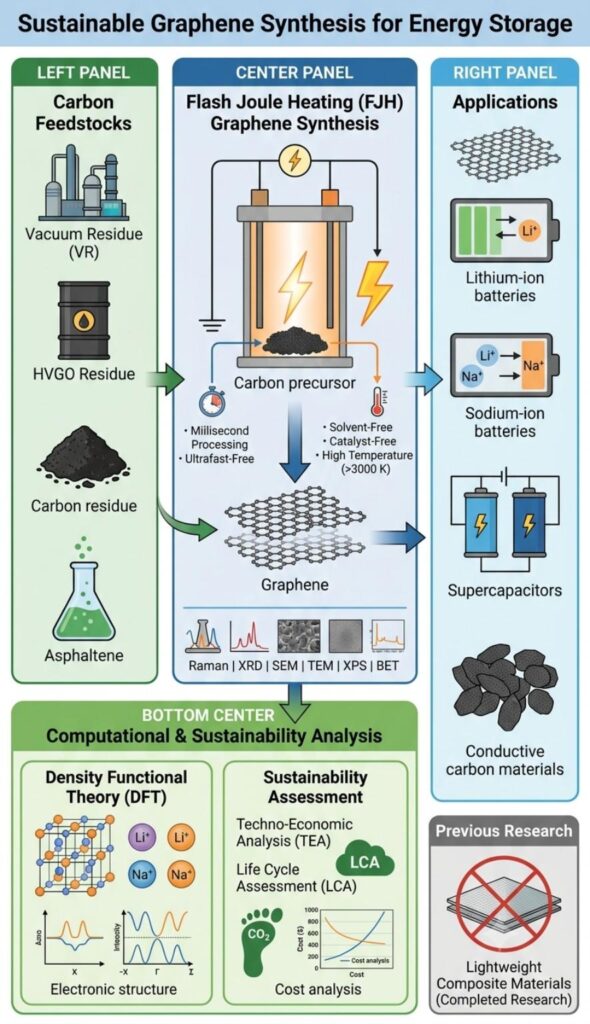
My research focuses on the sustainable synthesis of graphene and advanced carbon materials using the Flash Joule Heating (FJH) technique. This work investigates the rapid conversion of carbon-rich waste resources, including vacuum residue (VR), hydrotreated vegetable oil (HVGO) residues, and asphaltenes, into high-value graphene through millisecond-scale ultra-high-temperature processing. FJH offers a scalable, solvent-free, and energy-efficient alternative to conventional graphene production, enabling the direct transformation of low-value petroleum and industrial by-products into functional nanocarbons.

The research aims to establish structure–processing–property relationships by optimizing FJH operating conditions and evaluating the structural and electrochemical performance of the resulting graphene for energy-storage applications. Complementing the experimental work, computational studies based on Density Functional Theory (DFT) are employed to understand atomic-scale interactions in lithium-ion and sodium-ion battery materials, providing insights into ion diffusion, adsorption mechanisms, and electronic properties. These simulations support the rational design of next-generation electrode materials.
Beyond materials synthesis, my research incorporates Techno-Economic Analysis (TEA) and Life Cycle Assessment (LCA) to evaluate the economic feasibility and environmental sustainability of graphene production from waste feedstocks. This integrated approach bridges advanced materials engineering, computational modeling, and sustainability assessment to accelerate the development of scalable carbon technologies for future energy-storage systems. Prior to this research direction, I worked on the design and characterization of lightweight composite materials, developing expertise in structure–property relationships and advanced material processing.

Research Highlights

Thrust 2

Hard Carbon Anodes for Sodium-Ion Batteries

Led by Muetaz Mohammed
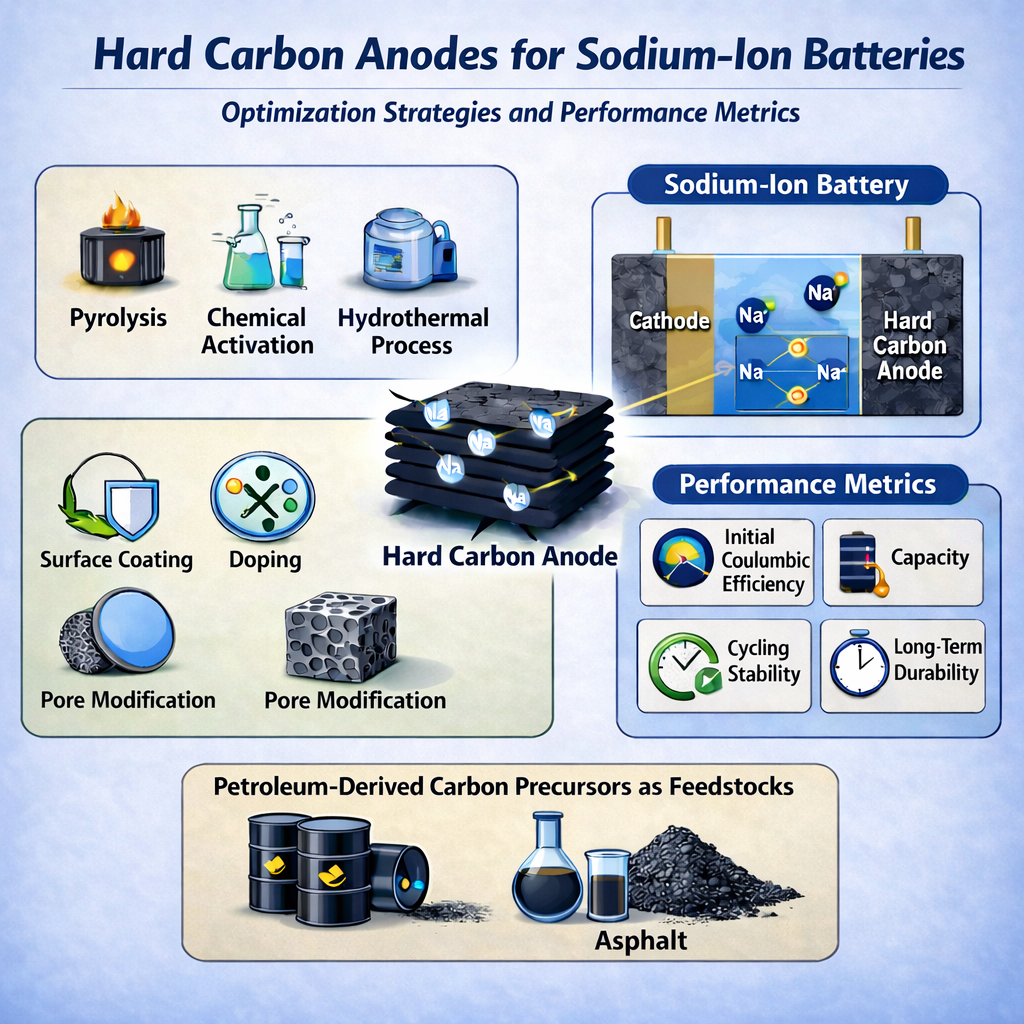
My current research focuses on developing hard carbon anodes for sodium-ion batteries using petroleum-derived carbon precursors as feedstocks, aiming to upgrade low-value refinery streams into high-value, battery-grade carbon materials. The work optimizes pre-treatment and post-treatment strategies to tailor the microstructure and surface/interface chemistry – such as disorder/defect density, porosity (including closed pores), and surface functional groups – to improve key electrochemical metrics, including initial coulombic efficiency, reversible capacity, and long-term cycling stability. By linking precursor chemistry and processing conditions to electrochemical behaviour, this research supports scalable pathways for converting refinery-side streams into advanced energy-storage materials.

Thrust 3

Waste-Derived Carbons for Energy Storage

Led by G M Ismail Hossain
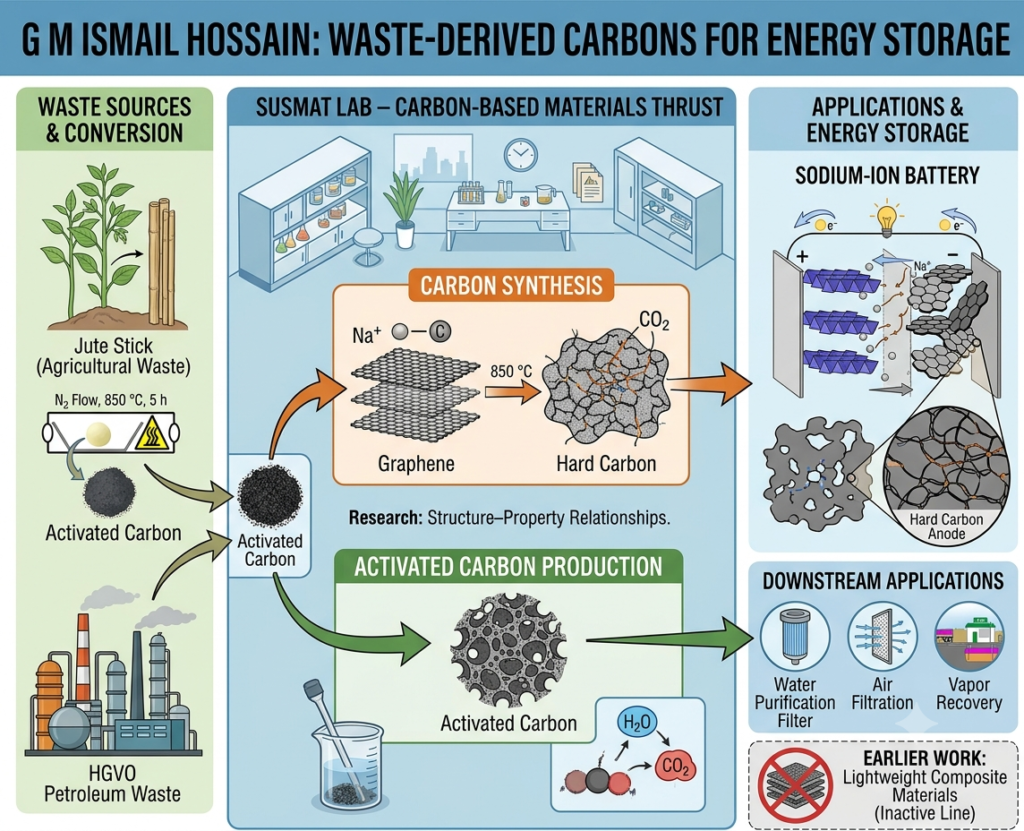
Hossain’s research centers on carbon — where it comes from, how processing shapes its structure, and what that structure allows it to do. At the SUSMAT Lab he co-leads the Carbon-based Materials thrust, synthesizing graphene and hard carbon and developing hard carbon anodes for sodium-ion batteries. Running alongside this is an effort to convert HGVO petroleum waste into activated carbon for a range of downstream applications, extending a longer-standing interest in waste-derived carbons that began with activated carbon produced from jute stick. Earlier work on lightweight composite materials informs his approach to structure–property relationships but is no longer an active line of research.

Thrust 4

Physics-Driven AI for Composites

Led by Md Naeem Hossain
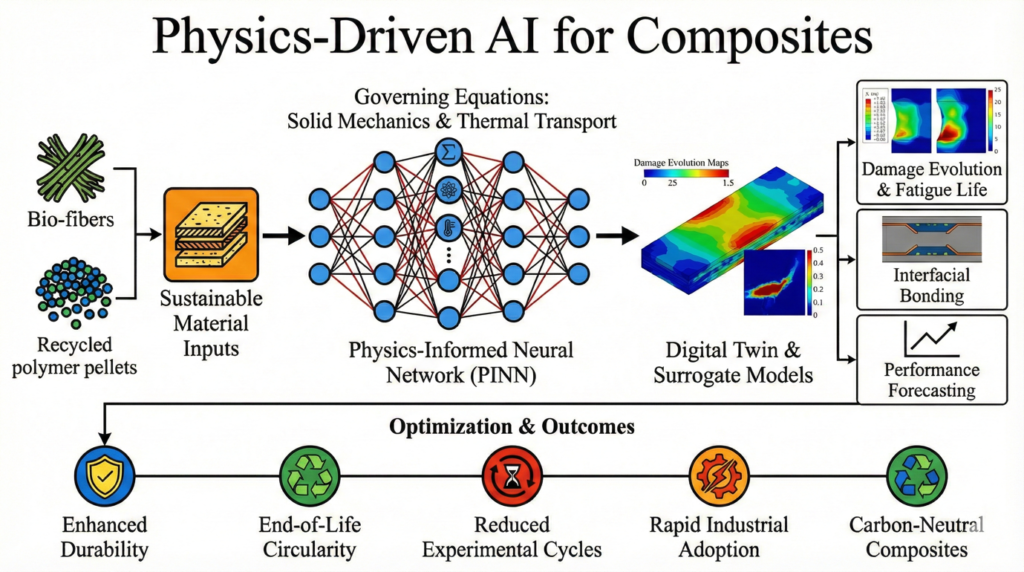
The AI-enhanced sustainable composites research team at SUSMAT is pioneering a hybrid approach to materials development by integrating Physics-Informed Machine Learning into the design of next-generation engineering solutions. By embedding fundamental governing equations – such as constitutive laws of solid mechanics and thermal transport – directly into neural network architectures, we aim to overcome the limitations of traditional black-box models, ensuring that our predictions are both statistically robust and physically consistent. Our primary objective is to develop advanced surrogate models that accurately simulate the damage evolution, fatigue life, and interfacial bonding of sustainable composites while requiring significantly less training data than conventional methods. This physics-driven digital framework allows us to optimize the structural integrity of composites utilizing bio-reinforcements and recycled matrices, specifically tailoring their architectures for enhanced durability and end-of-life circularity. The expected outcomes of this research include the creation of “digital twins” for sustainable materials that offer high-fidelity performance forecasting under extreme environments, a reduction in the energy-intensive experimental cycles typically required for material certification, and the establishment of a rigorous computational pipeline for the rapid industrial adoption of carbon-neutral composites.

Thrust 5

Techno-economic Analysis and Life-cycle Analysis

Led by Ahmed Bilal Shahul Hameed
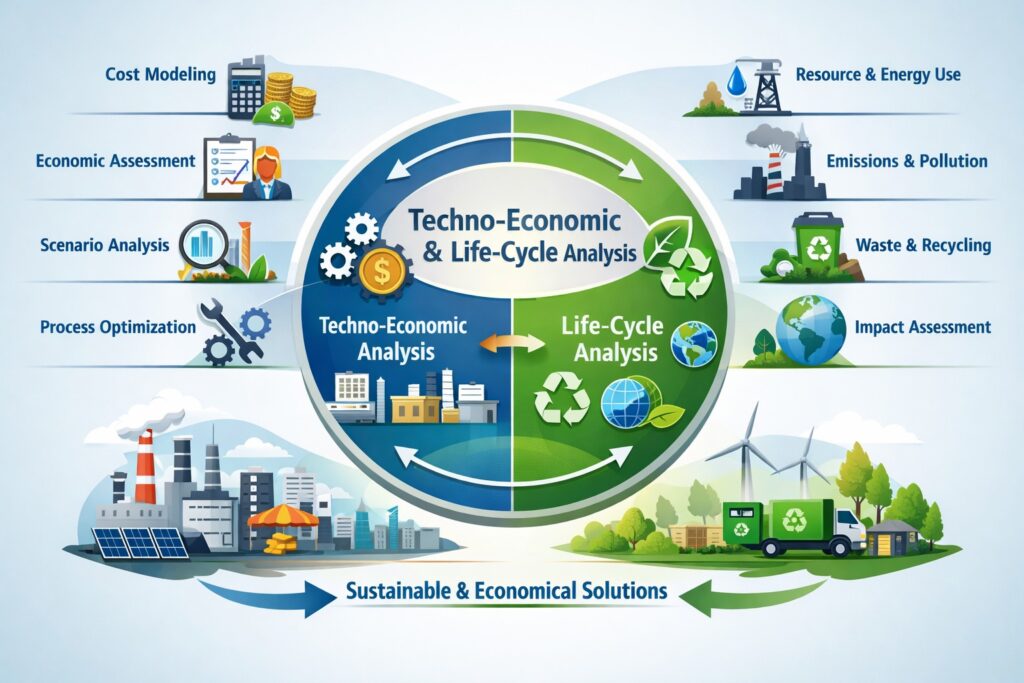
Beyond experimental research, our group evaluates sustainable energy technologies through an integrated techno-economic and environmental assessment framework. This approach allows us to understand not only how technologies perform technically, but also whether they are economically viable and environmentally sustainable.
Our techno-economic analysis (TEA) combines data collection, process modeling, and cost evaluation to estimate capital and operating costs, system performance, and commercial feasibility. We assess how scale influences cost, compare alternative technology pathways, evaluate multiple product options from similar processes, and analyze economic risks and uncertainties. This enables us to identify cost-intensive steps, guide process optimization, and set research targets that move technologies toward real-world deployment.

Complementing this, we conduct life-cycle analysis (LCA) to evaluate environmental impacts across the entire life cycle of a technology – from raw material extraction and manufacturing to operation and end-of-life management. Using established databases and process-based modeling tools, we quantify resource consumption, emissions, and environmental burdens to identify hotspots and opportunities for improvement.

By integrating techno-economic and life-cycle perspectives, we provide a comprehensive evaluation of emerging energy systems. This combined approach supports informed decision-making, advances sustainable innovation, and helps accelerate the transition toward low-carbon energy solutions.